
Study on the Trade-off Mechanism Between Flow Field Uniformity and Turbulent Pressure Pulsations in Back-Pressure Matching for Supersonic Wind Tunnels
DOI:
https://doi.org/10.5545/sv-jme.2026.1618Keywords:
Supersonic wind tunnel, Backpressure matching, Flow field uniformity, Pressure pulsation, Shear layerAbstract
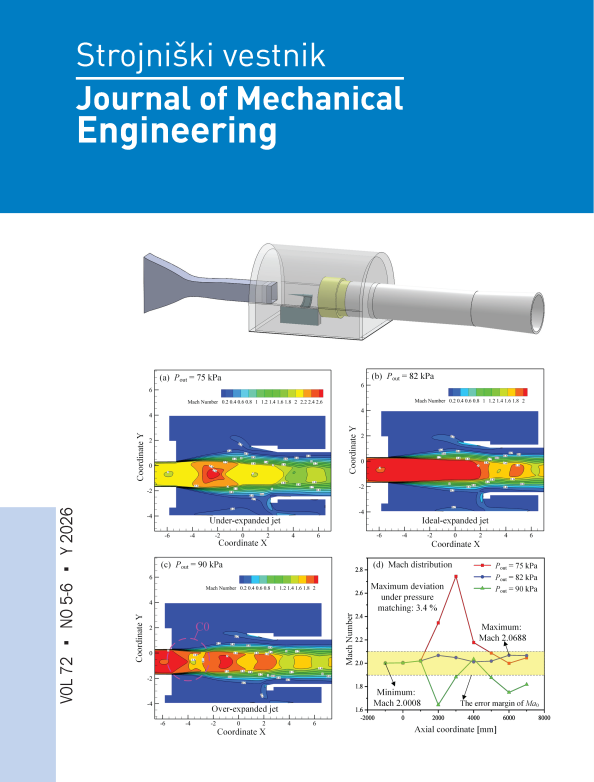
Supersonic wind tunnel testing is critical for aircraft aerodynamic configuration validation, where test chamber flow uniformity and turbulent pressure pulsations are core determinants of test data reliability. Existing back-pressure matching studies only optimize flow uniformity as a single objective, ignoring its coupling effect on pressure pulsations. This study proposes a rapid Reynolds-averaged Navier–Stokes (RANS)-based back-pressure matching method with the shear stress transport (SST) k−ω model to determine the optimal back-pressure Pm (ideal expansion at <5 % jet centerline Mach number deviation). Multiscale Large Eddy Simulations (LES) show ideal expansion extends the uniform core by 23 % with 3.4 % velocity pulsation standard deviation, while back-pressure mismatch causes up to 18 % total pressure loss via periodic shocks. Critically, ideal expansion yields the strongest pressure pulsations as unimpeded shear layer turbulence develops fully, uncovering a key trade-off: shock-based turbulence suppression reduces pulsations but sacrifices 7 % to 15 % flow uniformity. This work fills the research gap of coupled uniformity-pulsation analysis and proposes scenario-specific back-pressure strategies for supersonic wind tunnel tests.
Downloads
Published
How to Cite
Issue
Section
License
Copyright (c) 2026 The Authors

This work is licensed under a Creative Commons Attribution 4.0 International License.