
Phase Change Materials for Performance Enhancement in Household Refrigeration: A Review
DOI:
https://doi.org/10.5545/sv-jme.2026.1670Keywords:
household refrigerator, vapor-compression, phase change materials, heat transfer, energy efficiencyAbstract
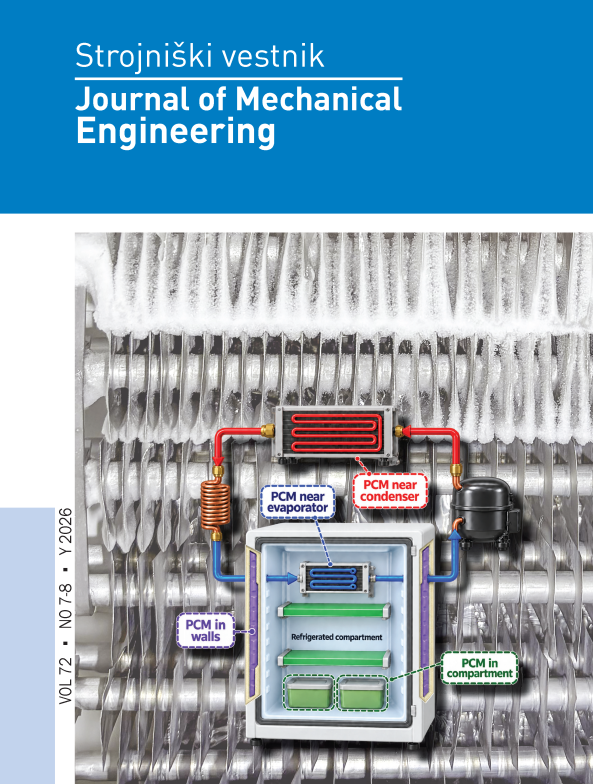
This paper reviews the use of phase change materials (PCMs) to improve the performance of household vapour-compression refrigerators. It first summarizes PCM selection criteria (phase-change temperature matching the thermostat range, high latent heat, adequate thermal conductivity, low supercooling/segregation, limited volume change, and chemical stability/safety). Furthermore, it outlines the main PCM classes (organic, inorganic, eutectic) together with practical measures such as encapsulation and conductivity enhancement via composites. The review also compiles examples of commercially available PCMs with melting temperatures relevant for refrigeration applications (approximately from −21 °C to +7 °C), highlighting that suitable market-ready solutions already exist. The core of the review compares PCM integration concepts at key locations: (i) at the evaporator, where improved heat transfer can raise evaporating temperature, extend compressor off-time, reduce temperature fluctuations, and support demand-side management; (ii) at the condenser, where lower condensing temperature and shorter on-time are possible but may be offset by more frequent compressor cycling; and (iii) inside the refrigerated compartment, where added thermal inertia dampens temperature swings, mitigates door-opening disturbances, and improves resilience during power outages. Finally, combined placements (e.g., evaporator + condenser) are discussed as a route to synergistic benefits, provided phase-change temperatures and geometry are selected appropriately.
Downloads
Published
How to Cite
Issue
Section
License
Copyright (c) 2026 The Authors

This work is licensed under a Creative Commons Attribution 4.0 International License.